How biotech startups can protect their IP in licensing and industry collaborations
Your science is solid, your patent is filed and the university is supportive. Now comes the harder part: turning that IP into a company you actually own, on terms that won’t haunt you in a Series B due diligence or an acquisition.
At our latest networking event, VISCHER broke down how startups can negotiate favorable terms in two of the most consequential early-stage agreements they will ever sign: a license agreement with a Swiss university, and a collaboration agreement with an industry partner.
Meet BaseLaunch
Our mission is to further grow the biotech ecosystem in the Basel Area, one of the world’s premier life sciences hubs.
We provide groundbreaking startups with the funding, expertise and infrastructure they need to transform their ideas into industry-shaping solutions. So far, we’ve supported companies that have collectively raised over $1 billion in follow-on financing.
We also collaborate with industry leaders, domain experts and organizations to create opportunities for knowledge exchange and partnerships. Events like this are a key part of that vision, bringing together thought leaders to tackle the challenges and opportunities shaping the future of biotech.
Meet the speakers

Christian Wyss
Partner and Co-Head of the Startup Desk
Christian opened the event, moderated the session and answered questions from the audience in the Q&A session.

Dr. Vincent S. Reardon
Managing Associate
Vincent walked us through how Swiss institutions publish their licensing terms and the financial and non-financial clauses that matter most to the startup (and investors).

Natacha Tang
Associate
Natacha explained how to structure collaboration agreements to keep ownership of your IP with you and offered practical advice on licensing terms, exclusivity and how to negotiate with larger partners.
Two legal building blocks every biotech startup must get right
”The legal agreements a biotech startup signs in its first years aren’t mere formalities. They’re essential for a startup's entire lifecycle, from fundraising through partnerships and, ultimately, the exit.
Christian WyssVISCHER
IP is the startup’s core, and every agreement the company enters into either strengthens or weakens its position. Two of those agreements are most common for early-stage founders, and are essential to get right from the get-go:
License agreements with Swiss universities: For most biotech founders in Switzerland, their startup’s journey begins as a spin-off. The technology was developed in a university lab which now owns the patent and securing the right to that IP is the startup’s first major transaction.
Industry collaboration agreements: As the startup develops its technology, partnerships with established industry players become attractive and necessary. These partnerships come with IP risks that are easy to underestimate and hard to unwind after a deal is signed.
IP in a Swiss university setting
You start as a scientist at a university and co-invent a technology with genuine potential. The university’s technology transfer office reviews the invention, files a patent application and the university becomes the owner of the IP.
You’re excited by what you’ve created and want to launch a spin-off with rights to use and develop the technology commercially.
The university, as a public institution, isn’t just going to hand over the IP. It will most likely want to retain ownership of the patent and license the rights to the spin-off. This lets the researchers use the IP, but ownership stays with the university.
At first, you might not get any issues and everybody is pulling in the same direction. But as the journey moves on, the situation often becomes somewhat complicated.
Each involved stakeholder has their own goal. The university’s innovation office, an internal or external technology transfer office (TTO), the founding researchers, potentially a professor who is also a co-founder, early employees, incoming investors and eventually big pharma will all have their own outlook on license’s terms.
You need to understand that dynamic early on. Only then can you navigate it to your benefit.
Things are changing in Swiss university licensing
The good news is that the Swiss university licensing landscape has become significantly more transparent over the past few years.
Several institutions now publish frameworks, guidelines and even annotated template agreements that give startups a clear reference point.
Three guiding posts
There are three principles that should shape how you approach the licensing process.
- Manage the time and effort to secure an appropriate license.
Not every license agreement needs to be a bespoke, heavily negotiated document. If a university’s standard terms are acceptable and your competitive situation demands speed, use them. But if your technology is highly differentiated and the stakes are high, invest the time and money to get the agreement right. - Anticipate key steps up to the exit.
The license you sign today will be reviewed by every future investor and potential acquirer. You need to think about your ideal terms for a Series A, a pharma partnership or an eventual M&A transaction. - Distinguish between financial and non-financial terms.
A founder who celebrates a low equity stake may have missed a problematic restriction on IP assignment. One who pushes back hard on royalty rates may have lost focus on step-in rights that could matter far more at exit.
Key financial terms
University license agreements typically include several financial components and you have to evaluate as a whole package.
A university might offer what looks like a favorable equity stake, but pair it with high royalties and a large sublicense fee. Another might seem aggressive on equity but offer very low royalties. The only meaningful comparison is the total financial burden across all components over the life of the company.
”If you hear from a fellow founder that a certain university gave them a very favorable equity deal, be sure to check the other terms before using that as your benchmark. It's common for universities to compensate a low equity stake with higher royalties or sublicense fees and vice versa.
Vincent ReardonVISCHER
The main components to understand are:
- Equity or exit fee (phantom stock)
Since startups have no cash at incorporation, universities generally accept either a share of equity in the spin-off or a phantom equity arrangement that pays out on exit. - Past patent costs
The startup may be asked to reimburse the university for patent costs that incurred before the spin-off was formed. The amount and timeline for repayment vary significantly and can be a big early-stage burden. - Royalties
A percentage of net sales. These costs arise once the product generates revenue. - Sublicense fees
A share of any payments the startup receives when it sublicenses the technology to a third party, like a pharma partner. This is often a significant number and one that directly affects collaboration deal economics. - License maintenance fees
Annual payments to keep the license in force, regardless of revenue. - Development milestone payments
Payments triggered by reaching milestones, negotiated individually at some universities. Universities are often open to adjusting the equity stake if the founder counters with something on the licensing fee side, which is precisely why treating financial terms in isolation can lead you to optimize the wrong number.
Universities are often open to adjusting the equity stake if the founder counters with something on the licensing fee side, which is precisely why treating financial terms in isolation can lead you to optimize the wrong number.
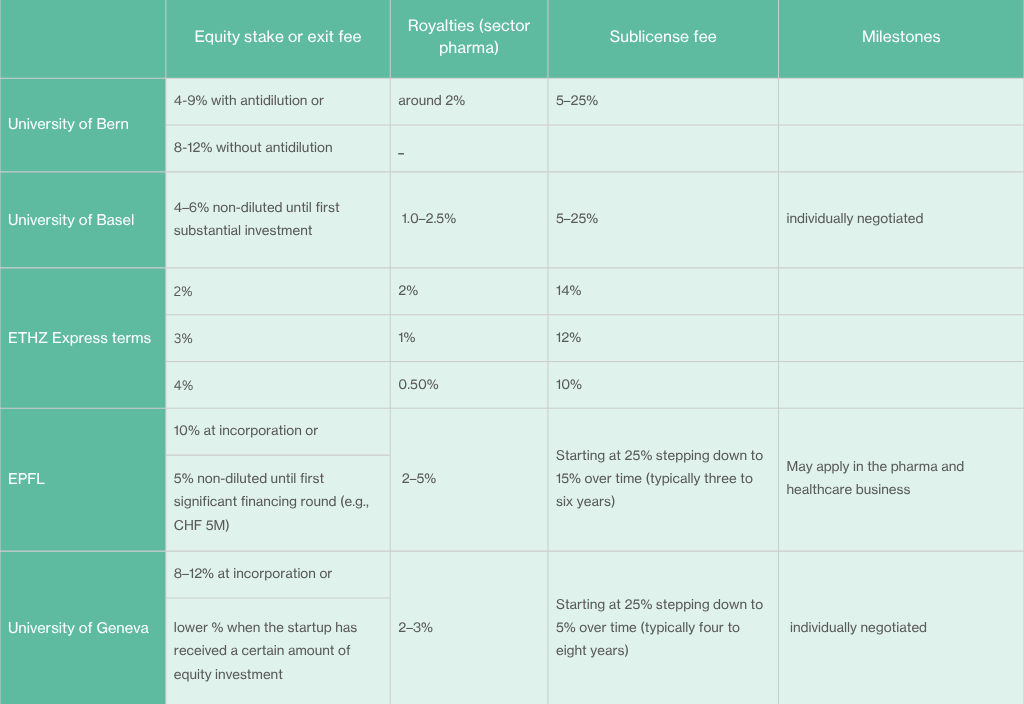
VISCHER compiled a comparison of published terms from five Swiss universities (actual terms in any given negotiation may differ):
Question from the audience
When a startup sublicenses to a mid-size pharma, which then sublicenses to a major pharma, does the university’s sublicense fee apply at each level?
It depends on what the license agreement says. It’s important to clearly define the terms of the startup’s relationship with the university, including how sublicense fees cascade through subsequent transactions. In some structures, the fee only applies at the first sublicensing event; in others, it can persist.
Key non-financial terms
Investors focus just as closely on the non-financial clauses as on the financial ones. These are the terms that determine what the startup can actually do with the IP.
When you receive a draft license agreement from the university, you have to first review what’s actually in the draft and decide whether the terms are acceptable. Then you also have to identify what’s missing entirely and push to get that included.
Three of the most important to-be-added terms are:
- Step-in rights for sublicensees
These protect downstream licensees (e.g. a pharma partner) if the startup’s license gets terminated. In that case, they could step into a direct relationship with the university rather than losing their rights entirely. - Assignment of license agreement
This is the ability to transfer the license itself to an acquirer. Without this, the startup may limit its options for structuring future deals. - Assignment of patent
This is about whether the startup can ever get the university to transfer actual ownership of the patent, not just the license rights. This alternative becomes relevant in certain exit scenarios (asset deals in particular, or if a big pharma’s internal policy requires acquiring the patent).
Depending on your technology and anticipated exit path, there are other terms worth flagging with your legal counsel before you sign.
IP in industry collaborations
Founders need to enter collaboration negotiations with a clear understanding of what their partner is trying to achieve.
Large pharma companies want to get a foot in the door before assets become expensive, assess technologies with their own scientists before committing to a major deal and keep competitors from accessing promising science. An early collaboration can give them all of that at a fraction of what they would pay in a later acquisition.
If you’re not familiar with those desires, your agreement can go wrong in many ways.
- Poorly defined confidentiality.
Before serious discussions begin, an NDA should be in place. Your NDA should cover not just technical data but also the startup’s strategic information, commercial plans and anything else a partner could use to their advantage. - Ambiguous IP ownership in joint work.
Without a clear contractual answer to who owns what, the default rules of Swiss law may apply, most likely resulting in co-ownership. That creates serious problems for the startup. Co-owned IP is difficult to license, difficult to enforce and very unattractive to investors. - Overly broad exclusivity.
A pharma partner may request exclusivity as a condition of collaboration. While reasonable in some cases, in others, it could keep the startup out of other valuable partnerships and reduce its leverage in future deal negotiations.
Protecting your IP
The solution to these risks lies in precise contract drafting. First, you need to understand the two types of IP that any collaboration agreement must address:
Foreground IP is the IP generated during the collaboration. The default position should be that Foreground IP belongs to the startup. The industry partner may receive a license to use the results for internal evaluation purposes, but ownership should remain centralized at the startup.
If you want Foreground IP to also be protected as confidential information (which you usually do), you need to say so explicitly, either in the NDA or in the collaboration agreement itself.
This is what such a clause could look like in your agreement:
8.1 No Implied License or Rights. Nothing in this Agreement shall constitute the grant of any Intellectual Property owned or controlled by a Party or any of its Affiliates, except to the extent expressly set forth herein.
8.2 Background IP. Each Party shall be and remain the sole owner of its respective Background IP.
8.3 Foreground IP. Any data and results, whether or not patentable, resulting from the performance of the Study Plan (“Results”) shall become the exclusive property of Startup and thus shall be deemed Confidential Information of Startup… Startup hereby grants to Industry Partner the right to use the Results for internal evaluation of the Startup Technology.
This confirms that nothing is shared by implication, it keeps Background IP exactly where it started, and it ensures that results generated during the collaboration belong to the startup, while still giving the industry partner something valuable: The right to evaluate the technology internally to make sure it’s a valuable partnership.
Licensing your IP
Most startups want to monetize their IP without giving away ownership through licensing. Here’s another real contract example to illustrate how licensing terms and exclusivity should be handled:
5.5 At the end of the Research Period, Startup shall submit to Industry Partner a written offer for (i) a non-exclusive license to Startup’s Sole Intellectual Property in the Research Field, and (ii) an exclusive license for Company’s interest in the Joint Intellectual Property (“License Offer”).
5.6 Upon receipt of the License Offer, the Parties shall enter into good faith negotiations for a period of 6 months (“Negotiation Period”) with a view to concluding a license agreement based on the License Offer, subject to mutual agreement.
5.7 During the Negotiation Period, Startup shall not enter into, or solicit, negotiations concerning the Sponsored Research; provided, however, that this Section 5.7 shall not restrict Startup from (a) raising additional equity or debt financing, or (b) engaging in Change of Control.
The startup’s core IP is offered on a non-exclusive basis, preserving the right to license to others. Exclusivity, where it applies, is limited to the jointly developed IP. The negotiation period is fixed at six months, giving both parties a clear deadline rather than an open-ended process.
And critically, the exclusivity during negotiations explicitly doesn’t prevent the startup from raising additional financing or engaging in a change of control transaction.
You should always define the scope exhaustively. Vague scope creates ambiguity that almost always works against the startup.
Three tips for your negotiations
VISCHER offered three practical tips that apply whether you’re entering a first collaboration or a more advanced licensing deal:
- Know what you want from it.
Is it cash, access to know-how, proof of concept? And think about how your startup fits into your potential partner’s strategy. Are you their best option, or one of several? That assessment tells you how hard you can push. - Be clear about your red lines from the start.
Ambiguity about what you’re willing to give away creates leverage for the other side. Define your non-negotiables early. - Use standardized templates where you can.
For NDAs, IP assignments and license clauses, an established framework speeds up negotiations, reduces legal costs and signals to investors that your IP landscape is clean and well-managed.
Question from the audience
When negotiating with big pharma partners who demand sublicensing rights to the startup’s core technology as a precondition for collaboration, how should founders respond?
This is a common pressure tactic, and it’s important to recognize it as such. If a pharma company is essentially asking for permanent, unfettered access to the startup’s core IP in exchange for a collaboration, that’s not a collaboration but a sale without an adequate price. If your IP is truly unique, you have more leverage than the other side may want you to believe.
Join our next event
At every BaseLaunch event, you get the chance to ask your own questions, share your science and connect with people who are shaping the future of biotech.
Don’t miss your chance—events like this one are fully booked in no time!
Join BaseLaunch
If you’re just at the start (pre-seed or seed stage) of creating your therapeutic venture, BaseLaunch could be your right next step!
You can get up to CHF 500,000 in funding, direct access to global biopharma leaders, help with company and team development and access to state-of-the-art lab space and infrastructure.